
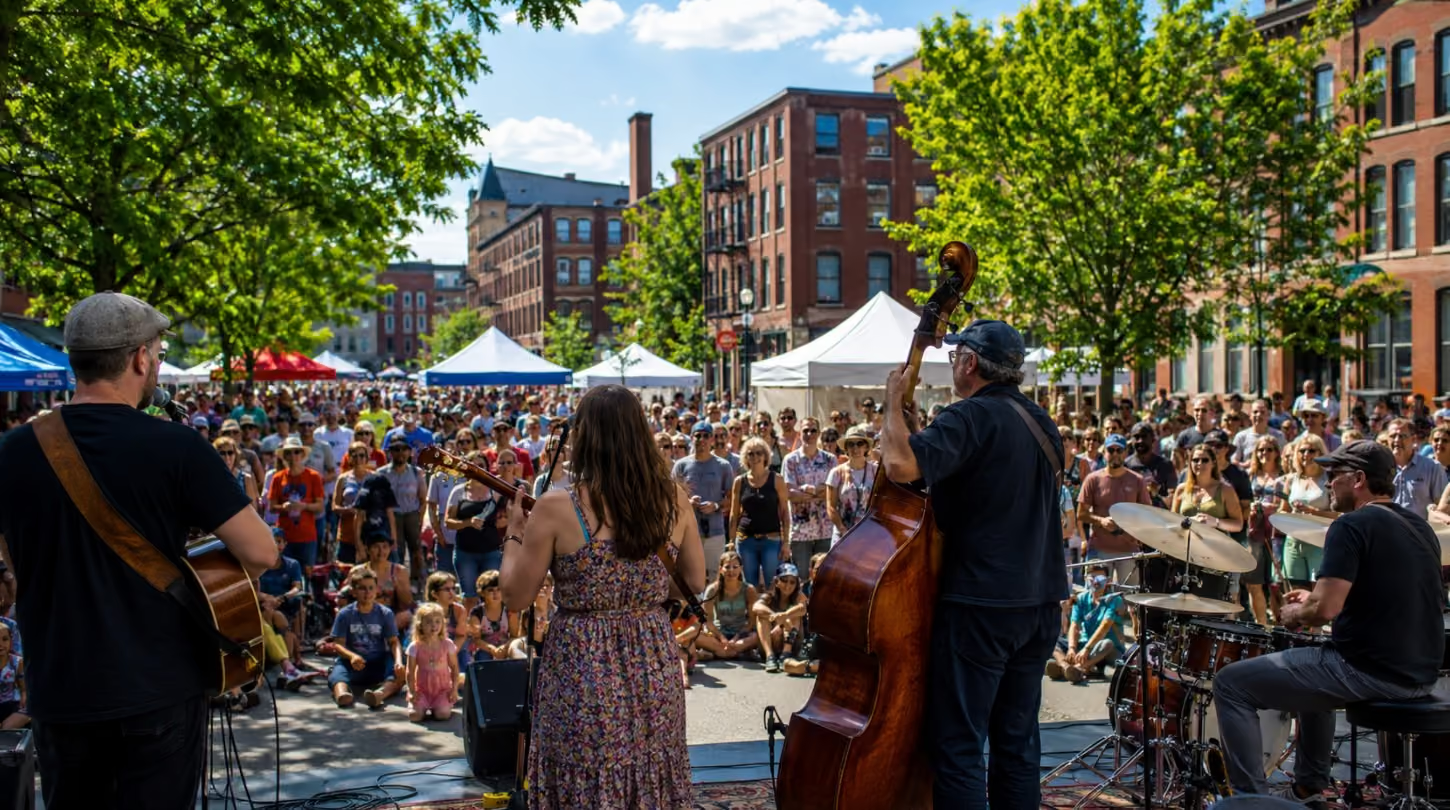
The Lowell Folk Festival is not simply a collection of concerts. For one summer weekend, downtown Lowell becomes a shared cultural space where music, dance, food, art, history, and community life come together.
The 2026 Lowell Folk Festival takes place July 24–26. Friday evening begins with the traditional Parade of Flags and opening performances. Programming continues from noon to 10:00 p.m. on Saturday and from noon to 6:00 p.m. on Sunday. Visitors should check the festival’s official 2026 performance schedule before arriving because individual performances and locations may be updated.
For residents, visitors, families, and people exploring the Merrimack Valley, the festival offers an unusually visible look at what makes the region’s summer culture distinctive.
Why Is the Lowell Folk Festival More Than a Music Event?
The most important thing to know is that the festival is built around participation rather than passive entertainment.
People can listen to a full performance at one stage, move between different downtown venues, join a dance audience, try food connected to a local cultural organization, meet regional artists, or spend time in the family activity areas.
That range matters because community culture is not represented by only one performance or one tradition. It appears through the interaction of many different groups sharing the same public space.
The festival’s history also reflects Lowell’s ability to turn a national event into a lasting local institution. Lowell hosted the National Folk Festival from 1987 through 1989. Local organizations and producing partners continued the event as the Lowell Folk Festival beginning in 1990.
This long-running collaboration helps explain why the festival feels connected to the city rather than temporarily placed within it.
How Does the Music Represent the Merrimack Valley’s Diversity?
The festival presents traditional music and dance as living practices—not as artifacts frozen in the past.
The 2026 program includes more than 60 scheduled performances and sessions. Visitors can hear or see traditions including Puerto Rican cuatro, Cabo Verdean funaná and batuque, Tuvan throat singing, South Indian santoor and tabla, Sicilian music, Haitian dance, Irish music, bluegrass, zydeco, jazz, blues, gospel, Andean scissors dance, Wampanoag social songs and dance, and other forms.
This range gives audiences several ways to participate:
- For dedicated music listeners: Individual sets provide time to focus on a particular artist or tradition.
- For curious visitors: Moderated demonstration sessions explore similarities and differences among artists from different backgrounds.
- For people who want to dance: The Dance Pavilion offers performances designed around movement and audience energy.
- For families: Shorter street and family-stage programs make it easier to sample different traditions without committing to one long performance.
In simple terms, the festival does not treat culture as a single category. It shows how local identity can include many traditions at the same time.
Why Is the Parade of Flags an Important Opening?
The 2026 festival begins Friday evening with a Parade of Flags from the City Hall area toward Boarding House Park.
More than 40 groups made up of local residents are scheduled to represent ancestral homelands during the procession. The Middlesex County Volunteers Fifes and Drums are leading the parade during a year that also marks Lowell’s bicentennial celebrations.
The parade offers a clear visual summary of the festival’s larger purpose: people can recognize their own heritage while participating in one shared Lowell event.
It is a celebration of difference, but it is also a demonstration of connection.
How Does Festival Food Support Local Community Organizations?
Food is one of the clearest examples of how the festival links culture with direct community participation.
According to the festival’s official global food information, its food vendors are nonprofit organizations, many of them based locally. They prepare dishes connected to their cultural heritage, and the proceeds from those sales support the organizations and their missions rather than becoming festival profit.
That means ordering a meal can serve several purposes at once:
- Trying food that may be new to the visitor.
- Learning about a cultural tradition through familiar community recipes.
- Supporting a local church, school, cultural organization, or nonprofit.
- Creating conversation between residents and visitors.
- Keeping community groups directly involved in the event.
The food areas are positioned around several festival locations, so visitors can incorporate meals into their performance plans rather than leaving downtown between shows.
The local takeaway is that food at the Lowell Folk Festival is not merely a concession service. It is part of the cultural programming.
How Does the Arts Market Highlight Lowell’s Creative Community?
The Experience Lowell Arts Market gives local creativity a visible place within the festival.
The 2026 market is scheduled for Saturday, July 25, from noon to 7:30 p.m., and Sunday, July 26, from noon to 5:00 p.m., at 222 Merrimack Street. More than 40 Lowell-area artists, makers, and cultural organizations are listed for the market. Visitors can review the Experience Lowell Arts Market information before attending.
This part of the festival may be especially useful for:
- Residents: A chance to discover artists and organizations working close to home.
- Visitors: A practical introduction to Lowell’s creative scene beyond the festival stages.
- New residents: A way to identify local groups, workshops, performances, and cultural spaces.
- Gift shoppers: An opportunity to purchase work directly from regional makers.
- Families: A lower-volume activity between performances or meals.
Why this matters: a city’s cultural identity depends not only on major institutions but also on the individual artists, makers, performers, and organizations working throughout the year.
What Can Families Experience at the Festival?
The Lowell Folk Festival is designed to be enjoyed in different ways, including by families with children.
The official program includes the Discovery Lowell Playspace, a family stage, interactive activities, cultural performances, craft-related programming, and shorter demonstrations. The festival FAQ also identifies a family activities area and advises that children of different ages attend the event.
A practical family plan may include:
- Choosing one or two priority performances.
- Building in time for the Playspace or family stage.
- Visiting food areas before the busiest meal period.
- Bringing water, sun protection, and weather-appropriate clothing.
- Planning a shaded break.
- Checking rules for prohibited items before leaving home.
- Using a garage or public transportation if staying longer than two hours.
Families do not need to follow the entire schedule. The event works well as a short visit, a half-day outing, or a full festival day.
Why Does Downtown Lowell Matter to the Experience?
The festival’s location is part of its character.
Performances take place among downtown streets, parks, churchyards, historic buildings, and public spaces connected to Lowell’s industrial and immigrant history. The surrounding Lowell National Historical Park interprets the city’s textile mills, canal system, worker history, and industrial development. The park also describes the festival as one of Lowell’s signature annual events.
That setting creates an experience that would be difficult to reproduce in a single field or enclosed venue.
Visitors move through the city as they move through the program. Historic architecture becomes part of the background, local businesses remain nearby, and different performance areas create distinct environments within a walkable festival footprint.
“The Lowell Folk Festival works because the city is not just its location. Downtown Lowell becomes part of the performance.”
What Can Visitors Still Experience on July 25 and July 26?
Readers visiting after the festival’s Friday opening still have most of the weekend programming available.
Saturday’s official schedule runs across several downtown stages from noon through approximately 10:00 p.m. Sunday programming begins at noon and concludes around 6:00 p.m. The program includes full concerts, dance sets, cultural demonstrations, family performances, collaborative sessions, food areas, and the arts market.
A good next step is to review the schedule and choose a small number of priorities rather than trying to attend everything.
Consider creating three categories:
- Must-see: One or two artists, sessions, or traditions you especially want to experience.
- Flexible: Performances located close to your planned food or market stops.
- Discover: At least one unfamiliar performance you can attend without researching it first.
The “discover” category is important. Folk festivals are often most memorable when visitors encounter a sound, dance form, instrument, or tradition they did not expect.
What Should Visitors Know About Parking and Transportation?
Because performances and activities occupy several downtown locations, transportation planning can make the day easier.
The festival’s official directions and parking page lists city garages, special event parking rates, street closures, disability parking information, public transportation, and shuttle service.
For 2026, the Lowell Regional Transit Authority is scheduled to provide free shuttle service between the Kennedy Center/Gallagher Terminal and the festival area. City garages are also available, with event pricing that varies by location. Visitors staying longer than two hours are advised to use a garage rather than relying on time-limited street parking.
Schedules, street access, parking availability, and transportation operations may change. Confirm the official information on the day of the visit.
What Does the Festival Reveal About Lowell and the Merrimack Valley?
The festival shows that culture in the Merrimack Valley is both historical and active.
Lowell’s history includes industrial development and generations of migration. The festival does not discuss that history only through museum interpretation. It demonstrates how communities continue to carry music, dance, food, art, language, and tradition into present-day public life.
It also shows how a major regional event depends on cooperation among:
- Residents.
- Local nonprofits.
- Artists and tradition bearers.
- Cultural organizations.
- Public agencies.
- Volunteers.
- Downtown businesses.
- Regional visitors.
- Local and national festival partners.
That cooperation is part of the experience even when visitors do not see the planning behind it.
For people thinking about moving to Lowell or another Merrimack Valley community, events like this offer information that property listings cannot provide. They show how public spaces are used, how residents gather, what organizations are active, and how the area expresses local identity.
Readers exploring the region throughout the year can also browse La Casa Group’s community and local lifestyle resources.
Why Is the Festival Especially Meaningful in 2026?
The 2026 event takes place during Lowell’s bicentennial year.
That timing gives the festival an additional role. It celebrates not only the traditions represented by individual performers and communities, but also Lowell’s continued evolution since its incorporation in 1826.
The festival’s opening announcement connects the Parade of Flags, the United States’ 250th anniversary, and Lowell’s bicentennial programming.
The result is not a simple historical reenactment. It is a celebration of how history continues through people, neighborhoods, organizations, and creative traditions.
In Summary: What Makes the Lowell Folk Festival Important?
The Lowell Folk Festival matters because it gives the Merrimack Valley a large, public, and accessible place to experience culture together.
Music may attract people downtown, but the full experience comes from the combination of:
- Traditional performances.
- Cultural demonstrations.
- Local nonprofit food vendors.
- Regional artists and makers.
- Family activities.
- Historic public spaces.
- Volunteer participation.
- Community representation.
The festival shows that Lowell’s identity is not limited to its past. It is continually shaped by the people who live, create, cook, perform, organize, and gather there today.
La Casa Group’s Local Perspective
La Casa Group’s local perspective is that community events can tell people something important about a place that housing statistics alone cannot.
For residents, the Lowell Folk Festival is an opportunity to reconnect with downtown, support local organizations, and experience traditions represented throughout the Merrimack Valley.
For people considering a move, it offers a direct look at Lowell’s public spaces, cultural diversity, walkability, local organizations, and summer lifestyle.
“Choosing a community is not only about comparing homes. It is also about understanding how people gather, celebrate, and participate in local life.”
Readers considering Lowell as a place to live can review what more housing options may mean for Lowell buyers this summer or explore La Casa Group’s guidance for first-time buyers considering Lowell.
A good next step is to experience the area in person, explore the surrounding streets and neighborhoods, and consider how the community fits your everyday priorities—not only your event-day experience.
Frequently Asked Questions
When is the 2026 Lowell Folk Festival?
The festival runs from Friday, July 24, through Sunday, July 26, 2026. Friday programming begins with the Parade of Flags and evening performances. Saturday programming runs from noon into the evening, and Sunday programming runs from noon through approximately 6:00 p.m. Check the official festival schedule for current details.
Is the Lowell Folk Festival free?
Yes. Festival performances and activities are free to attend. Food, merchandise, parking, and optional donations are separate expenses. The festival encourages donations because producing the event still requires substantial funding.
Is the Lowell Folk Festival family-friendly?
Yes. The event includes family activities, a Playspace, shorter performances, cultural demonstrations, and food options. Families should review the schedule, festival rules, transportation plan, and weather before attending.
What kinds of music and dance are presented?
The 2026 schedule includes traditions from the United States and around the world, such as zydeco, blues, bluegrass, Irish music, Puerto Rican cuatro, Cabo Verdean music, Tuvan throat singing, South Indian instrumental music, gospel, Haitian dance, Andean scissors dance, Wampanoag songs and dance, and other forms.
Where does the festival take place?
Programming is spread across downtown Lowell, including Boarding House Park, the Market Street area, St. Anne’s Churchyard, the Dance Pavilion area, family spaces, and selected street-performance locations. Visitors should expect to walk between venues.
Where should visitors park?
City garages and selected event-rate parking areas are available. A free LRTA festival shuttle is also scheduled from the Kennedy Center/Gallagher Terminal. Review the official parking and transportation information before traveling because access and availability may change.
Why is the Lowell Folk Festival important to the Merrimack Valley?
The festival provides a shared public space where residents, cultural groups, nonprofits, artists, businesses, volunteers, and visitors can participate in the region’s cultural life. It connects Lowell’s historical identity with traditions that remain active in the community today.
Contact La Casa Group
Cinthia Ulloa
La Casa Group
Brokered by KW Metropolitan
Office Phone: 603-232-8282
Mobile Phone: 603-945-2337
Website: https://www.lacasagroup.com
Office Address: 168 South River Road, Bedford, NH 03110
Se habla español. La Casa Group can assist Spanish-speaking buyers and sellers.
.avif)