
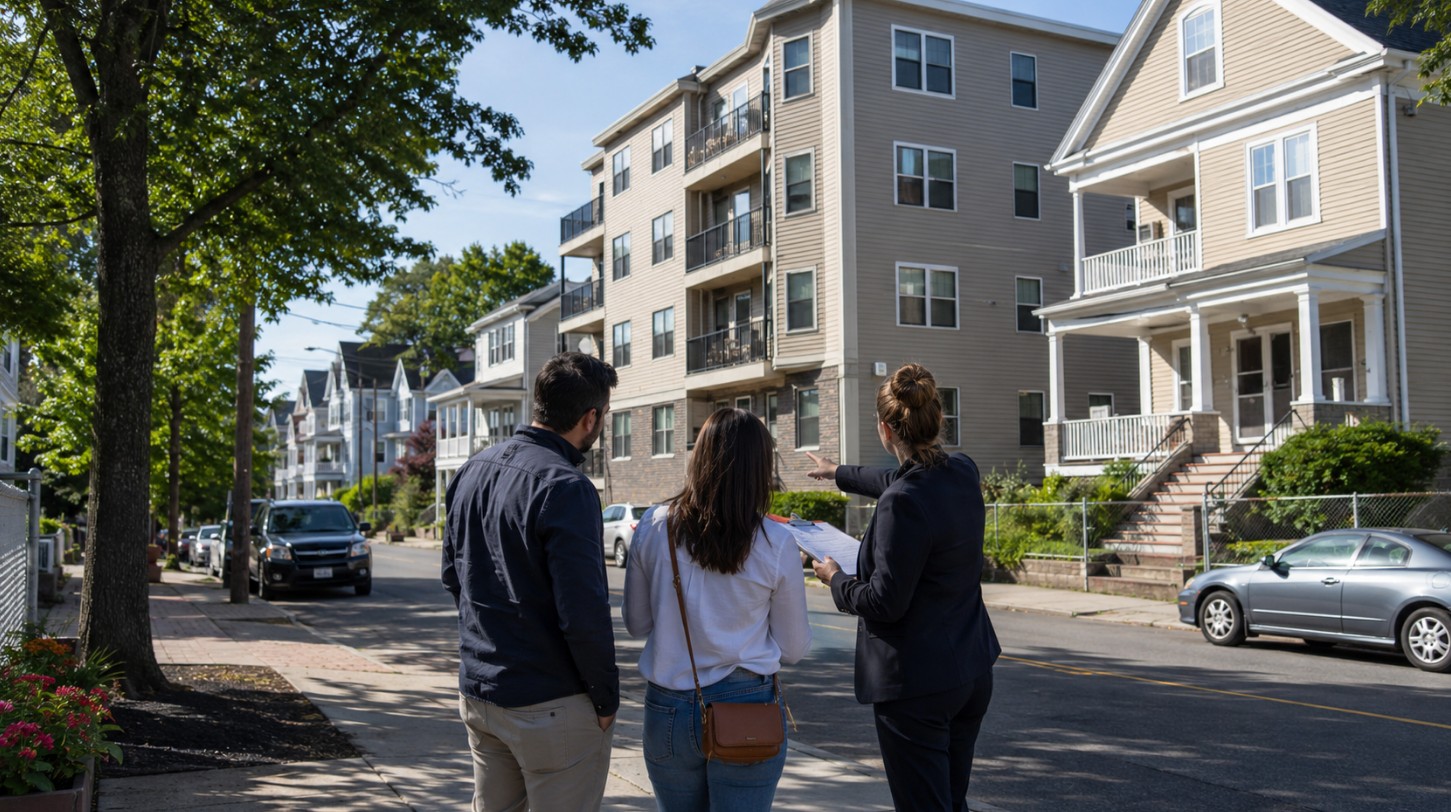
Buying a home in Lawrence can involve comparing very different property types within the same search.
One listing may be a condominium in a converted residential building. Another may be a two- or three-family property with rental potential. The next may be a detached single-family home with a yard and private driveway.
The listing prices may be close, but the condition risks and ownership responsibilities can be very different.
The most important thing to know is that property condition should not be judged only by appearance. New flooring, fresh paint, modern cabinets, and updated lighting may improve presentation, but they do not tell you the condition of the roof, foundation, plumbing, electrical service, heating system, drainage, common areas, or association finances.
A better comparison asks three questions:
- What condition is the property in today?
- Who will be responsible for repairing each component?
- What could the property realistically cost to maintain after closing?
Why Does Property Type Change the Way Condition Should Be Reviewed?
Each property type divides responsibility differently.
With a condo, you generally purchase your individual unit together with an ownership interest in shared common areas. Massachusetts condominium properties are governed through their master documents, deed, bylaws, rules, and Chapter 183A. Buyers therefore need to consider both the physical condition of the property and the association responsible for managing it. Massachusetts condominium guidance explains this ownership structure in more detail.
With a multifamily property, the buyer may become responsible for several residential units, shared stairways, porches, utility systems, safety equipment, exterior components, and possible landlord obligations.
With a single-family home, the buyer normally assumes responsibility for nearly the entire property, including the structure, exterior, mechanical systems, driveway, drainage, landscaping, and land.
This means a $10,000 issue does not have the same impact in every property type. In a condo, it may be an association responsibility funded through reserves or a special assessment. In a multifamily or single-family property, it may become the owner’s direct expense.
Start With Three Levels of Property Condition
A useful way to compare homes is to separate condition into three levels.
Level 1: Cosmetic condition
Cosmetic items affect appearance and comfort but are not normally the highest-risk issues.
Examples include:
- Paint colors
- Cabinet finishes
- Flooring wear
- Older countertops
- Dated light fixtures
- Minor wall damage
- Landscaping appearance
These items may still cost money, but they should not distract you from more important concerns.
Level 2: Functional and structural condition
These are the systems that allow the property to operate safely and reliably.
Review items such as:
- Roof condition
- Foundation and structural movement
- Water entry and drainage
- Plumbing supply and waste lines
- Electrical panels, service, and visible wiring
- Heating and cooling equipment
- Windows and exterior doors
- Insulation and ventilation
- Chimneys
- Porches, stairs, and decks
- Moisture or pest evidence
- Smoke and carbon-monoxide safety equipment
Massachusetts home-inspection standards cover readily accessible and observable systems such as the roof, exterior, structure, electrical, plumbing, heating, cooling, interiors, insulation, and ventilation. The state’s current residential inspection rules apply to residential buildings with one to four units and condominium units within buildings of any size, subject to the regulation’s provisions and exceptions. Review the Massachusetts residential home-inspection guidance before preparing an offer or inspection strategy.
Level 3: Ownership, financial, and documentation condition
Some risks will not be visible during a showing or even during a standard inspection.
Examples include:
- Unpermitted renovations
- Condo association financial weakness
- Upcoming special assessments
- Missing maintenance records
- Incomplete rental or occupancy documentation
- Insurance limitations
- Unclear utility arrangements
- Deferred capital projects
- Existing code concerns
- Lead-paint documentation
- Repair work completed without proper approval
This third level is where the differences among condos, multifamily homes, and single-family homes become especially important.
How Should Buyers Evaluate a Condo’s Condition?
A condo should be evaluated as two connected purchases:
- The private unit
- The building and association shared with other owners
Review the condition inside the unit
Inside the unit, look at many of the same components you would review in another home:
- Plumbing fixtures and visible supply lines
- Electrical outlets and panel access
- Heating and cooling equipment serving the unit
- Windows and doors
- Signs of moisture
- Interior ceilings and walls
- Appliances included in the sale
- Bathroom ventilation
- Flooring and subfloor movement
- Evidence of repairs or repeated leaks
Ask which systems serve only the unit and which are shared with the building.
For example, an individual unit may have its own heating system, while water lines, drainage stacks, the roof, exterior masonry, hallways, or foundation may be common responsibilities.
Look beyond the front door
A clean unit can still be located in a building with expensive deferred maintenance.
Review accessible common areas and ask about:
- Roof age and repair history
- Exterior siding, masonry, or trim
- Foundation and basement condition
- Shared plumbing
- Common electrical equipment
- Fire alarms and life-safety systems
- Hallways and stairways
- Porches, decks, and balconies
- Parking areas
- Drainage and snow-management areas
- Elevators, when applicable
- Shared heating or hot-water equipment
A standard inspection may not answer every question about inaccessible common components. Condo documents, association records, insurance information, meeting minutes, budgets, and maintenance history therefore become important parts of the condition review.
Examine the association’s financial condition
Physical problems become financial problems when the association lacks enough money to address them.
Buyers should ask for available documents such as:
- Master deed
- Declaration of trust or association documents
- Bylaws
- Rules and regulations
- Current budget
- Reserve-fund information
- Recent meeting minutes
- Master insurance information
- Current condo fee
- Planned projects
- Pending or recently completed special assessments
- Information about owner delinquencies, when available through the proper review process
Massachusetts licensing materials identify items such as condo documents, budgets, meeting minutes, master insurance, reserve information, and the 6D certificate as important parts of a condominium transaction.
What to watch for: A lower condo fee is not automatically better. A very low fee may reflect efficient management, but it may also mean the association is postponing repairs or contributing too little to reserves.
The local takeaway: Compare the condo’s monthly fee with what it covers, the building’s condition, and the association’s ability to handle future projects.
How Should Buyers Evaluate a Multifamily Property’s Condition?
A multifamily property requires the buyer to think like both a homeowner and a future building operator.
Even when the buyer plans to occupy one unit, the entire property matters.
Inspect every accessible residential unit
Do not assume that the condition of one renovated unit represents the entire building.
Compare:
- Kitchens and bathrooms
- Heating systems
- Electrical panels
- Plumbing fixtures
- Windows
- Ceilings and walls
- Moisture evidence
- Ventilation
- Flooring
- Unit entrances
- Smoke and carbon-monoxide equipment
- General maintenance consistency
One unit may have been renovated while another still contains older plumbing, electrical components, windows, or heating equipment.
Identify shared and separate utilities
Ask how the property’s systems are arranged.
Important questions include:
- Does each unit have a separate electrical meter?
- Are heating systems separate?
- Is hot water shared or separately supplied?
- Who pays for water and sewer?
- Are laundry utilities shared?
- Are there owner-paid common-area utilities?
- Are any spaces being used in a way that may not match their documented purpose?
Utility arrangements can affect both monthly expenses and future renovation plans.
Review the entire building envelope
A multifamily property may have more occupied space and more points where maintenance problems can develop.
Pay particular attention to:
- Roof surfaces and flashing
- Multiple porches or exterior stairways
- Foundation walls
- Basement moisture
- Main plumbing and waste lines
- Main electrical service
- Shared hallways
- Fire separation between units
- Exterior siding or masonry
- Gutters and drainage
- Retaining walls
- Parking and access
- Basement storage
- Boiler rooms and mechanical areas
A property that produces rental income can still create financial strain if major building systems need immediate work.
Verify permits and municipal records
Before relying on a renovation, additional unit, finished basement, altered bedroom count, or changed floor plan, ask whether the work was properly permitted and completed.
The City of Lawrence’s Inspectional Services Department processes relevant permits, licenses, and certificates and provides access to its permitting systems. Buyers may also use the city’s property assessment resources to review available parcel and assessment information. Municipal records do not replace professional inspections, title review, appraisal, legal guidance, or lender requirements, but they can help buyers identify questions that deserve further investigation.
Common mistake: Assuming that an existing use, room, or unit must be approved because it appears in a listing or has been used that way for several years.
A good next step is to compare listing information with available city records and ask the appropriate professionals to resolve discrepancies before closing.
Consider lead-related responsibilities
For homes built before 1978, Massachusetts requires property-transfer lead-paint notification. State law also establishes additional responsibilities when a child under six resides in a pre-1978 property.
Buyers can review the state’s property-transfer lead-paint notification requirements and available lead-history resources. This can be especially important for buyers considering an older multifamily property that may be owner-occupied, rented, or renovated after purchase.
Lead records and disclosures should not be treated as substitutes for advice from licensed lead inspectors, legal professionals, or relevant public agencies.
How Should Buyers Evaluate a Single-Family Home’s Condition?
A single-family home usually gives the owner more direct control. It also places more direct responsibility on the owner.
There is no condo association collecting fees for shared exterior repairs. There may be no rental income helping offset the cost of a future roof or heating system.
Evaluate the entire property
A single-family inspection should include the building and surrounding site.
Look at:
- Roof and attic
- Foundation and basement
- Exterior walls and siding
- Windows and doors
- Heating and cooling systems
- Electrical service
- Plumbing
- Water entry
- Grading and drainage
- Driveway and walkways
- Decks, porches, stairs, and railings
- Trees near the structure
- Retaining walls
- Garage or outbuildings
- Sewer or septic considerations, as applicable
- Any additions or finished spaces
The yard and drainage pattern can matter as much as the interior. Water moving toward the foundation, damaged gutters, poorly placed downspouts, or aging retaining walls may lead to expenses that are easy to overlook during a short tour.
Estimate future replacement timing
A system does not need to be broken today to affect your decision.
Ask about the approximate age, service history, and remaining useful life of:
- Roof
- Boiler or furnace
- Air-conditioning equipment
- Water heater
- Electrical panel
- Windows
- Exterior siding
- Main sewer line
- Driveway
- Deck or porch
- Major appliances
An older but properly maintained system may perform better than a newer system that was installed incorrectly or neglected. Age is one clue—not the entire conclusion.
The local takeaway: A single-family home may offer more independence, but buyers should maintain a larger personal repair plan because most exterior and structural costs will belong to them alone.
Which Property Type Has the Lowest Condition Risk?
No property type automatically has the lowest risk.
The better choice depends on the specific building, its maintenance history, its documentation, and the buyer’s financial comfort.
Condo
- May fit buyers who: Prefer less direct exterior maintenance and are comfortable sharing decisions and expenses with an association.
- Main condition advantage: Some major exterior responsibilities may be shared.
- Main condition risk: The buyer has less control over association decisions, reserve funding, project timing, and special assessments.
- Review carefully: Unit systems, common areas, association finances, insurance, meeting minutes, rules, and planned projects.
Multifamily property
- May fit buyers who: Want multiple units, possible rental income, or an owner-occupied investment approach.
- Main condition advantage: Rental income may help support ownership costs when the property and tenancy perform as expected.
- Main condition risk: More units and shared systems can create more maintenance, compliance, management, and capital-repair responsibilities.
- Review carefully: Every unit, utilities, structure, safety systems, permits, occupancy information, tenant-related documentation, and major expenses.
Single-family home
- May fit buyers who: Prefer more privacy, control, and direct decision-making.
- Main condition advantage: The owner can generally choose when and how to maintain the property, subject to laws, permits, financing, and other applicable requirements.
- Main condition risk: Most repair costs belong to one owner.
- Review carefully: Structure, mechanical systems, site drainage, exterior condition, maintenance history, and future replacement costs.
In simple terms, the safest property is not necessarily the newest or most recently renovated. It is often the property whose condition, responsibilities, records, and probable expenses the buyer understands most clearly.
How Can Buyers Compare Repair Costs Fairly?
Do not compare two properties using list price alone.
Create a condition-adjusted comparison.
For each home, estimate:
Costs that may be needed immediately
Examples:
- Active leaks
- Unsafe electrical conditions
- Failed heating equipment
- Damaged stairs or railings
- Significant plumbing problems
- Broken windows
- Missing safety equipment
- Severe moisture concerns
- Lender-required repairs
Costs that may arise within one to three years
Examples:
- Aging water heater
- Exterior painting
- Appliance replacement
- Minor roof work
- Porch repairs
- Window improvements
- Heating-system servicing or replacement planning
Costs that may arise within three to ten years
Examples:
- Full roof replacement
- Major masonry work
- Boiler or furnace replacement
- Siding replacement
- Drainage correction
- Major electrical modernization
- Main plumbing or sewer work
- Condo capital projects
- Parking-lot or common-area work
Then ask:
- Will I pay this cost directly?
- Is it included in a condo fee?
- Could it result in a special assessment?
- Is it shared with tenants or other owners?
- Does the property generate income that may offset expenses?
- Do I have enough savings after closing?
- Will the lender or insurer require action sooner?
This produces a more realistic comparison than deciding that the home with the newest kitchen must be the best value.
What Should Lawrence Buyers Do Before Submitting an Offer?
A strong condition review begins before the formal home inspection.
During the showing, document questions about:
- Visible water staining
- Sloping floors
- Cracks
- Older electrical equipment
- Heating-system age
- Roof appearance
- Window condition
- Peeling paint
- Porches and exterior stairs
- Shared utilities
- Unfinished renovations
- Additions or converted spaces
- Unusual odors
- Signs of repeated patching
- Condo common areas
- Tenant or unit access for multifamily properties
Next, separate your questions into four groups:
- Items the seller or listing agent may be able to explain
- Items for a licensed home inspector
- Items requiring a specialist
- Items requiring document, municipal, lender, insurance, or legal review
Under Massachusetts’ current inspection rules, sellers generally cannot accept an offer that is conditioned on the buyer waiving, limiting, or restricting the buyer’s choice to obtain a home inspection, except where a regulatory exception applies. The inspection must be completed by an appropriately licensed inspector and should produce a written evaluation. Buyers should review the exact requirements and their proposed contract terms with qualified professionals.
La Casa Group’s guide to the importance of home inspections provides additional inspection questions for buyers in Massachusetts and New Hampshire. Buyers can also review common first-time buyer mistakes before deciding how condition, financing, and offer terms fit together.
What Are the Most Common Condition-Comparison Mistakes?
Focusing only on renovated rooms
A modern kitchen may improve enjoyment, but it does not repair a failing roof, old main plumbing line, weak association budget, or unstable porch.
Treating every inspection issue equally
A damaged outlet cover and major structural movement should not receive the same weight.
Prioritize:
- Safety
- Structure
- Water
- Major mechanical systems
- Legal or documentation concerns
- Function
- Cosmetic preference
Assuming a condo eliminates maintenance costs
Condo owners may not perform every exterior repair personally, but they still fund common expenses through condo fees, reserve contributions, and possible assessments.
Assuming rental income will cover every multifamily expense
Income projections should be reviewed alongside vacancy risk, repairs, utilities, insurance, financing, management, maintenance, and legal responsibilities.
Spending all available cash on the purchase
A buyer who closes with no repair reserve may struggle even when the property’s issues are ordinary rather than catastrophic.
Skipping records because the property looks well maintained
Visible condition and documented condition are different. Permits, association records, lead documentation, maintenance history, and municipal information may reveal questions that are not obvious during a tour.
What Is the Best Property-Condition Strategy for July Buyers?
For buyers planning a late-July or summer search, use showings to examine exterior conditions that may be easier to observe in clear weather.
Look at:
- Rooflines
- Gutters and downspouts
- Foundation grading
- Exterior stairs
- Porches
- Masonry
- Siding
- Window condition
- Pavement
- Retaining walls
- Yard drainage patterns
- Common landscaping
- Parking surfaces
Also ask for information that reveals how the property performs during other seasons.
Examples include:
- Basement water history
- Ice-dam history
- Heating costs
- Snow-removal responsibility
- Drafts or insulation concerns
- Frozen-pipe history
- Roof-leak history
- Condo winter-maintenance procedures
Good summer appearance should not prevent the buyer from asking winter-performance questions.
A Practical Property-Condition Comparison Process
Before choosing among a condo, multifamily property, and single-family home, follow this sequence:
Step 1: Define your maintenance comfort level
Decide how much direct repair responsibility you are willing to accept.
Step 2: Establish a post-closing reserve
Do not use every available dollar for the down payment and closing expenses without discussing the full financial plan with your lender and other appropriate professionals.
Step 3: Compare responsibility—not only condition
Identify whether each major system belongs to you, a condo association, multiple owners, or another party.
Step 4: Review available documents
Request and evaluate the records appropriate to the property type.
Step 5: Complete professional inspections
Use a properly licensed Massachusetts home inspector and consider specialists when the property or initial findings justify additional evaluation.
Step 6: Estimate near-term and long-term ownership costs
Consider immediate work, likely replacement timing, condo assessments, rental operations, and personal maintenance reserves.
Step 7: Decide based on the full property
Balance price, condition, location, layout, monthly payment, future expenses, and lifestyle fit.
For broader preparation, La Casa Group’s free homebuyer guide walks buyers through the process from search to closing. Buyers who are still comparing the city itself can also review what buyers should know about living in Lawrence.
La Casa Group’s Local Perspective
La Casa Group’s local perspective is that buyers should compare responsibility as carefully as they compare visible condition.
A condo with an attractive interior may still require careful review of the building and association. A multifamily property may offer additional possibilities, but the buyer must understand the condition and operation of the entire building. A single-family home may provide greater control, but it also concentrates maintenance responsibility with one owner.
“The question is not only whether a property needs work. The more important question is who will be responsible, when the work may be needed, and how it fits the buyer’s budget.”
For Lawrence buyers, a good next step is to build a property-specific checklist before touring. That checklist should reflect the property type, the buyer’s financing, available savings, maintenance comfort, and long-term plan.
La Casa Group helps buyers across Lawrence and Northern Massachusetts compare property types, prepare inspection questions, understand the buying process, and evaluate the practical differences among available homes.
The team also supports Spanish-speaking buyers. If you prefer to discuss your home search and inspection questions in Spanish, La Casa Group can assist.
Frequently Asked Questions
Is a condo inspection different from a single-family home inspection?
Yes. A condo buyer should review the interior unit and accessible systems, but the buyer must also consider common areas, shared building components, association documents, insurance, budgets, reserve information, meeting minutes, and possible assessments. The exact inspection scope depends on the property and access available.
What should I inspect in a Lawrence multifamily home?
Inspect every accessible unit, the roof, foundation, basement, porches, shared stairways, utilities, plumbing, electrical systems, heating equipment, fire-safety components, exterior condition, parking, and drainage. Also compare the listing with available permits, assessment information, occupancy documentation, leases, expenses, and other records relevant to the purchase.
Is a renovated property less risky?
Not automatically. Renovations may improve condition, but buyers should verify the quality, scope, permits, and age of systems that were not replaced. A renovated kitchen does not confirm the condition of the roof, foundation, plumbing, electrical system, heating equipment, or drainage.
How much money should I reserve for repairs after closing?
There is no single amount that fits every property. The appropriate reserve depends on the property type, age, condition, inspection findings, upcoming projects, association finances, insurance, financing, and the buyer’s overall budget. Buyers should discuss the full financial picture with their lender and appropriate financial professionals.
Can I review Lawrence permit and property records before buying?
Available property assessment and permit resources can help buyers identify questions about renovations, additions, unit counts, and property information. Records may be incomplete or require interpretation, so they should be reviewed with the appropriate real estate, legal, municipal, inspection, appraisal, and lending professionals.
Can La Casa Group help me compare different property types?
Yes. La Casa Group can help buyers compare condos, multifamily properties, and single-family homes based on condition, price, monthly expenses, responsibilities, lifestyle needs, and long-term plans. The team can also help coordinate the next steps with inspectors, lenders, attorneys, and other professionals involved in the transaction.
Contact La Casa Group
Cinthia Ulloa
La Casa Group
Brokered by KW Metropolitan
Office Phone: 603-232-8282
Mobile Phone: 603-945-2337
Website: https://www.lacasagroup.com
Office Address: 168 South River Road, Bedford, NH 03110
Se habla español. La Casa Group can assist Spanish-speaking buyers and sellers.
A good next step is to contact La Casa Group to discuss your Lawrence home search, property-type options, inspection priorities, and buying plan.